Отраслевые подборки (УДК)
Издания подборки 1 - 10 из 2967
1.
Автор:
Alekseeva Sardaana A.

Год выпуска: 2016

This article is devoted to regards the actual problems of cultural livelihoods of Indigenous Peoples of the North-East of Russia, in particular, the traditional practice of reindeer herding of the Tongues, contemporary consideration of adaptive coping strategies and new opportunities in the context of globalization. The work on the basis of the method of expeditionary field work subjected to scientific analysis of the specifics of nomadic reindeer culture of the peoples of the North (for example, the Evens and Evenki), which marked the structural uniformity of phenomena such as the trajectory of continuous movement “feeding the landscape” (pet or wild animal), the cycle paths of movement of human groups within the range of nomadic and economic structure-phenological calendar. Space-time representation, captured in the traditional calendar, and structural uniformity of the economic cycle, the structure of livelihoods and culture are reflected in the picture of the world of the studied ethnic groups. Reindeer hunters, that move during the hunting year, within a closed circle route, developed a “circular” model of life in contrast to the “linear” type of culture of life support (semi-settled fishermen, whose route ran along the main feeding substance - river). Today we can talk about more or less sustainable model of cultural livelihoods of Indigenous Peoples, which is characterized by a combination and synthesis of modern (urban) elements and archaic (northern) cultures. Installing problem identified the following three main lines of research: traditional and modern practices in the conduct of reindeer hunting and fishing in life-support system of the peoples of the Tungus; the main options for the economic models of life of the peoples of the North; reconstruction of ethnolocal options for livelihoods of the Tungus. Currently, different ethnolocal groups of indigenous peoples has developed a range of livelihood strategies, which are important not only historical and cultural meanings, but also social and economic factors
Статья посвящена изучению актуальной проблемы культуры жизнеобеспечения коренных малочисленных народов Северо-Востока России, в частности традиционной практики ведения оленеводства у тунгусов, рассмотрению современных адаптивных стратегий выживания и новых возможностей в условиях глобализации. В работе на основе использования метода экспедиционных полевых работ подвергнута научному анализу специфика кочевой ется структурной однородностью таких явлений, как траектория непрерывного движения "кормящего ландшафта" (домашнего или дикого животного), путей цикличного передвижения человеческих коллективов в пределах ареала кочевания и строения хозяйственно-фенологического календаря. Пространственно-временные представления, запечатленные в традиционном календаре, также структурно однородны хозяйственному циклу, строению культуры жизнеобеспечения и отражены в картине мира изучаемых этносов. Оленеводы-охотники, кочевавшие в течение промыслового года по замкнутому круговому маршруту, выработали "круговую" модель жизнедеятельности в отличие от "линейного" типа культуры жизнеобеспечения (полуоседлые рыболовы, промысловые пути которых тянулись вдоль главной кормящей субстанции – реки). Сегодня можно говорить о более-менее устойчивой модели культуры жизнеобеспечения коренных малочисленных народов Севера, характерной чертой которой является комбинация и синтез элементов современной (урбанизированной) и архаичной (северной) культур. Проблемная установка определила следующие три основные исследовательские линии: традиционные и современные практики ведения оленеводства в охотничье-промысловой системе жизнеобеспечения у тунгусов, основные варианты хозяйственных моделей жизнедеятельности народов Севера и реконструкция этнолокальных вариантов жизнеобеспечения у тунгусов. Выявлено, что в настоящее время в разных этнолокальных группах коренных малочисленных народов Севера сложился целый спектр стратегий жизнеобеспечения, в котором важное значение имеют не только историко-культурные, но и социально-экономические факторы
2.
Автор:
Bereznitsky Sergey V.

Год выпуска: 2019

The article is devoted to the possibility of application of the well-known ethnographers, historians, cultural scientists, sociologists of the concept of binary oppositions of the French scientist Claude levy-Strauss (1908–2009) for cross-cultural research of ethnic features of the use of energy by “hot” industrial and “cold” traditional societies in the Russian North in the 18th‑21th centuries. “Hot” societies seek to control energy, constantly increasing its production, consumption, and the amount of information and knowledge associated with these processes. “Cold” societies try to limit themselves to the reproduction of already long-discovered ancestors, established technologies of life support system, preservation of traditional conditions of their original existence. The proximity of the resettlement and indigenous peoples in the Northern regions for several centuries inevitably leads to contacts and mutual exchange of cultural values, including in the field of energy consumption. However, the problem of choosing the optimal way of energy use in severe climatic conditions remains unresolved
Статья посвящена рассмотрению возможности применения хорошо известной этнографам, историкам, культурологам, социологам концепции бинарных оппозиций французского ученого Клода Леви-Стросса (1908–2009) для кросс-культурного исследования этнических особенностей использования энергии "горячими" индустриальными и "холодными" традиционными обществами на российском Севере в XVIII–XXI веках. "Горячие" общества стремятся контролировать энергию, постоянно увеличивая ее производство, потребление, а также связанные с этими процессами объемы информации и знаний. "Холодные" общества стараются ограничиться воспроизводством уже давно открытых предками, устоявшихся технологий системы жизнеобеспечения, сохранения традиционных условий своего самобытного существования. Соседство переселенческих и коренных народов в северных регионах на протяжении нескольких веков неизбежно приводит к контактам и взаимообмену культурными ценностями, в том числе и в сфере потребления энергии. Однако до сих пор остается окончательно нерешенной проблема выбора оптимального пути использования энергии в суровых климатических условиях
3.
Авторы:
Brown Alison, Браун Элисон, Иванова-Лоу Татьяна, Пирс Элеонор, Аргунова-Лоу Татьяна Ивановна, Пирс Элеонор
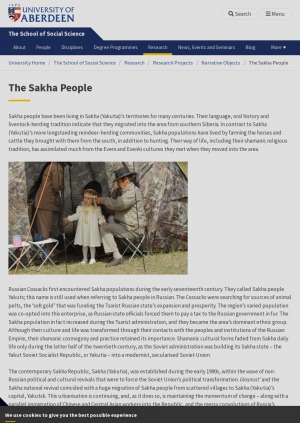
Об истории и развитии народа Саха
4.

Количество страниц: 4 с.

The NE Siberia is known as a region with supreme finds of mammoth fauna and the Ice Age occupation sites preserved in permafrost. The frozen grounds contribute to preservation of the most unique paleontological, palaeobotanical and organic archaeological material exposed from the primary cryolithic geological layers of the late Pleistocene riverine valleys. Investigations carried out in the upper and middle reaches of the Kolyma River basin of the Republic of Sakha (Yakutia) in 2013–2018 brought new evidence on the natural habitats of the Paleolithic peopling of this region with the earliest findings 14C-dated >44 000 years ago. The field data allow the reconstruction of sequenced environmental conditions for the last tens of thousand of years and the modeling of human biological and cultural adaptation to the mid-Last Glacial and the extreme Last Glacial ecosystems within modern forest-tundra.
Северо-Восток Сибири известен как регион c важными находками мамонтовой фауны и стоянок древних людей последнего ледникового периода, сохраненных в вечной мерзлоте. Минусовые термические условия содействуют сохранению уникальных палеонтологических, палеоботанических и органических археологических материалов, краткосрочно вымытых на поверхность из первичных криолитических геологических слоев древних речных долин эпохи плейстоцена. Проведенные работы в бассейне верхнего и среднего течения реки Колыма в пределах Республики Саха (Якутия) в 2013–2018 гг. принесли новые, подтвержденные радиоуглеродными датами свидетельства обитания человека эпохи палеолита в этом регионе более чем 44 тыс. л. н. Данные полевых исследований позволяют провести реконструкцию природных условий последних десятков тысяч лет и моделирование биологической и культурной адаптации человека к экстремальным условиям последнего интергляциала и гляциала в поясах современной лесотундры.

The mid-last glacial habitats of the palaeolithic peopling of the Kolyma basin, Nortn-East Yakutia=Следы обитания человека эпохи палеолита в интергляциале бассейна Колымы, северо-восток Якутии / J. Chlachula, M. Yu. Cheprasov, T. F. Obada, S. E. Grigoriev // V Северный археологический конгресс, 11-14 декабря 2019, Ханты-Мансийск : тезисы докладов. – Екатеринбург ; Ханты-Мансийск : Альфа-Принт, 2019. – С. 58-60.
5.

Количество страниц: 12 с.

Frozen graves of Yakutia, a chronological sequence / S. Duchesne, R. Bravina, V. Popov [и др.] // Вестник археологии, антропологии и этнографии. – 2020. – N 4 (51). – С. 120-130. — DOI: 10.20874/2071-0437-2020-51-4-11.
DOI: 10.20874/2071-0437-2020-51-4-11
6.
Автор:

Количество страниц: 19 с.

In this article the technique of classification of the Early Holocene microblade industries on sites with mixed cultural layers of Central Yakutia (Tuymaada valley) is discussed. This technique is based on classification in the complexes on stone artifacts of microliths, as a characteristic for the Sumnagin culture. Materials from sites are associated with the Mesolithic on the basis of the technical-typological and statistical analysis of materials from precisely stratified sites of the Sumnagin Culture of the Aldan and Olekma river basins. The stone inventory of the Sumnagin culture is based on the maximal use of blades from which practically all stone tool industrial products were produced, except for large cutting instruments. The presence of microblade tools in the common statistics of tool types is supported by a big amount of blades and the tools made of them. Prevailing amount of blades in relation to the flake tools, absence of ceramics or its small amount, in some cases, also testifies in favour of early dating. On the basis of analysis, the Sumnagin cultural complex on 11 sites of Tuymaada Valley is established: Kapitonovka, Kil'dyamtsy III, Severo-Zapadnaya II, Fermennoe Ozero, Syrdakh VI, Zernovaya II, Us'-Khatyng I, V, Vladimirovka IV, and Horo I, III. On about 25 sites where the microblades industries are excavated, at expansion of works the assumption of presence the Mesolithic stone assemblage in cultural layers can prove to be true.
Работа посвящена проблеме изучения мезолита в Центральной Якутии. Здесь было известно небольшое количество стоянок сумнагинской культуры, характеризующихся смешанными культурными комплексами, и датированных этим временем лишь по аналогиям инвентаря. В работе предложена методика определения раннеголоценовых комплексов в смешанных культурных слоях, основанная на выделении в общих комплексах каменного инвентаря микролитов, в большей степени характерных для сумнагинской культуры. Проведённый анализ позволил выделить сумнагинский культурный комплекс на 11 памятниках Туймаады. На ещё около 25 памятниках, где обнаружены микропластинчатые индустрии, при расширении работ, может подтвердиться предположение о наличии в культурных слоях мезолитического каменного инвентаря

Dyakonov, V. M. On the Problem of Classification of Microblade Industry Sites with Mixed Cultural Layers in the Mesolithic of Central Yakutia (on Materials from the Tuymaada Valley) / Victor M. Dyakonov // North Pacific Prehistory : archaeological studies journal. — 2007. — Vol. 1. — P. 129-147.
7.
Авторы:
Frolovskiy Dmitriy , Фроловский Дмитрий

Год выпуска: 2019

О Якутии
10.
Авторы:
Liesowska Anna , Лесовска Анна

Год выпуска: 2015

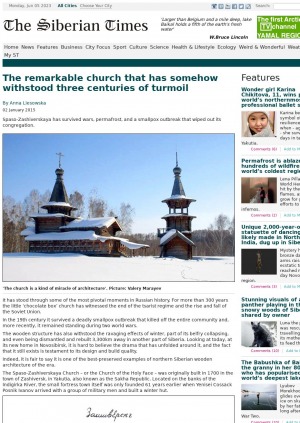
О древней Спасо-Зашиверской церкви, Якутия. С комментариями полярника Бориса Леванова, директора Института археологии и этнографии Сибирского отделения Академии наук Анатолия Деревянко