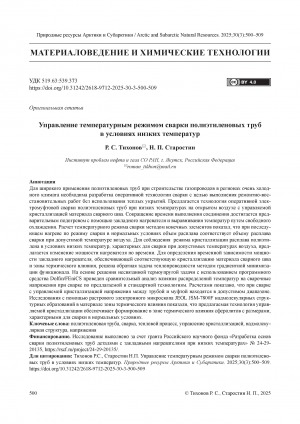
Управление температурным режимом сварки полиэтиленовых труб в условиях низких температур = Temperature control for welding polyethylene pipes in low-temperature conditions
Статья в журнале
Русский
621.791.46/.48(571.56)
10.31242/2618-9712-2025-30-3-500-509
полиэтиленовая труба; сварка; тепловой процесс ; управление кристаллизацией ; надмолекулярная структура; напряжения; polyethylene pipe; welding; thermal process; crystallization control ; supramolecular structure; stressa
С. 500-509
Природные ресурсы Арктики и Субарктики = Arctic and Subarctic natural resources: научный журнал
Якутск, Академия наук Республики Саха (Якутия)
Основан в 1996 г.
Выходит 4 раза в год
2618-9712 (print), 2686-9683 (online)
Природные ресурсы Арктики и Субарктики : научный журнал / главный редактор И. И. Колодезников ; Академия наук РС (Я), Якутский научный центр СО РАН, Северо-Восточный федеральный университет им. М. К. Аммосова, Министерство образования и науки РС (Я). - Якутск : Академия наук Республики Саха (Якутия), 2018-. - 2025, Т. 30, N 3. - 353-522 с.
To promote the widespread use of polyethylene pipes in constructing gas pipelines in cold climates, it is essential to develop a welding technology that enables repair and restoration without the need for heated shelters. This article investigates the operational electrofusion welding of polyethylene pipes at low temperatures in open air, focusing on controlling the crystallization of the weld material.To reduce the time required for making a joint in low temperatures, we propose using a preheating method using an embedded heater, followed by equalizing temperatures through free cooling. Calculations of the welding temperature regime, performed using the finite element method, indicate that subsequent heating, according to the welding parameters under standard conditions, results in a melt volume that corresponds to the weld melt volume at acceptable air temperatures.To maintain the appropriate crystallization conditions for the polyethylene melt during welding in low-temperature environments, we suggest varying the heater power over time. To determine the time dependence of the embedded heater’s power required for proper crystallization of the weld material and heat-affected zone, we solve the inverse problem of thermal conductivity through the gradient minimization of the functional.Using Dolfin/FEniCS software, we conducted a comparative analysis of temperature distributions and their effects on welding stresses during the implementation of the proposed method versus standard technology. Our calculations demonstrate that when utilizing controlled crystallization, the stresses between the pipe and coupling remain within permissible limits. Studies conducted with a JEOL JSM-7800F scanning electron microscope on supramolecular structural formations in the heat-affected zone revealed that the proposed controlled crystallization technique enables the formation of spherulites in the heat-affected zone, with sizes comparable to those observed in welding under normal conditions.
Тихонов, Р. С.
Управление температурным режимом сварки полиэтиленовых труб в условиях низких температур / Р. С. Тихонов, Н. П. Старостин ; Институт проблем нефти и газа СО РАН // Природные ресурсы Арктики и Субарктики. - 2025, Т. 30, N 3. - С. 500-509. - DOI: 10.31242/2618-9712-2025-30-3-500-509
DOI: 10.31242/2618-9712-2025-30-3-500-509
Войдите в систему, чтобы открыть документ

QR-код документа

Как сканировать QR-код?
Для пользователей Android:
- Скачайте приложение для сканирования QR-кодов (Google Play)
- Откройте скачанное приложение;
- Наведите камеру на QR-код.
Для пользователей iPhone:
- Откройте приложение "Камера";
- Наведите камеру на QR-код;
- Нажмите на всплывающее уведомление.