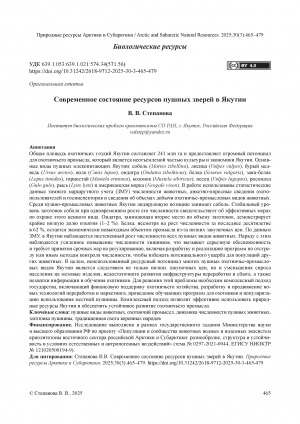
Современное состояние ресурсов пушных зверей в Якутии = The current status of fur-bearing animal resources in Yakutia
Статья в журнале
Русский
636.934(571.56)
10.31242/2618-9712-2025-30-3-465-479
пушные виды животных; охотничий промысел; динамика численности пушных животных; заготовка пушнины; традиционная охота коренных народов; fur-bearing animals ; hunting; population dynamics in animal species; fur harvesting; traditional hunting of indigenous peoples
С. 465-479
Природные ресурсы Арктики и Субарктики = Arctic and Subarctic natural resources: научный журнал
Якутск, Академия наук Республики Саха (Якутия)
Основан в 1996 г.
Выходит 4 раза в год
2618-9712 (print), 2686-9683 (online)
Природные ресурсы Арктики и Субарктики : научный журнал / главный редактор И. И. Колодезников ; Академия наук РС (Я), Якутский научный центр СО РАН, Северо-Восточный федеральный университет им. М. К. Аммосова, Министерство образования и науки РС (Я). - Якутск : Академия наук Республики Саха (Якутия), 2018-. - 2025, Т. 30, N 3. - 353-522 с.
The total expanse of hunting territories in Yakutia covers approximately 241 million hectares, providing substantial potential for hunting activities, which are a vital component of both the region’s cultural heritage and economic framework. The fur-bearing mammal fauna in Yakutia includes species such as sable (Martes zibellina), fox (Vulpes vulpes), brown bear (Ursus arctos), wolf (Canis lupus), muskrat (Ondatra zibethicus), squirrel (Sciurus vulgaris), white hare (Lepus timidus), ermine (Mustela erminea), Siberian weasel (Mustela sibiricus), arctic fox (Vulpes lagopus), wolverine (Gulo gulo), lynx (Lynx lynx), American mink (Neogale vison). This study used data derived from winter route surveys, questionnaires completed by hunting service providers and state inspectors, and records related to hunting and commercial animal production. Among the species studied, the sable holds particular significance. The consistent level of sable harvesting, alongside an observed increase in its population, suggests the effectiveness of conservation measures implemented to protect this valuable species. The muskrat ranks second in terms of harvest volume and exhibits a notably low seizure rate of 1-2%. Despite a 62% increase in squirrel populations over the past decade, squirrels remain economically unviable targets due to their low market prices. According to winter route surveys, populations of all fur-bearing animals in Yakutia are gradually increasing. However, this trend is accompanied by a rise in predator populations, raising ecological concerns and requiring prompt regulatory actions, including population control. The underexploited potential of fur-bearing animals in Yakutia stems from low market prices, limited consumer demand, underdeveloped processing and marketing infrastructure, and insufficient information and training for hunters. Addressing these challenges requires a comprehensive government strategy involving financial support for hunting, advancement of innovative processing and marketing technologies, hunter training programs, and initiatives promoting locally sourced fur products. This integrated approach would ensure the sustainable, efficient use of Yakutia’s natural resources and the long-term viability of its hunting industry.
Степанова, В. В.
Современное состояние ресурсов пушных зверей в Якутии / В. В. Степанова ; Институт биологических проблем криолитозоны СО РАН // Природные ресурсы Арктики и Субарктики. - 2025, Т. 30, N 3. - С. 465-479. - DOI: 10.31242/2618-9712-2025-30-3-465-479
DOI: 10.31242/2618-9712-2025-30-3-465-479
Войдите в систему, чтобы открыть документ




QR-код документа

Как сканировать QR-код?
Для пользователей Android:
- Скачайте приложение для сканирования QR-кодов (Google Play)
- Откройте скачанное приложение;
- Наведите камеру на QR-код.
Для пользователей iPhone:
- Откройте приложение "Камера";
- Наведите камеру на QR-код;
- Нажмите на всплывающее уведомление.