- Книга (1758)
- Газета (61)
- Журнал (261)
- Автореферат диссертации (47)
- Изоиздание (1)
- Аудиоиздание (62)
- Видеоиздание (347)
- Неопубликованный документ (5)
- Нотное издание (12)
- Фотография (33)
- Статья (353)
- Библиографический указатель (55)
- Словарь (81)
- Календарь (1)
- Брошюра (26)
- Буклет (8)
- Электронное издание (2)
- 3D-модель (6)
- Грампластинка (7)
- Веб-архив (787)
- Чукотский (28)
- Долганский (11)
- Английский (30)
- Эскимоский (3)
- Эвенкийский (76)
- Эвенский (234)
- Французский (1)
- Немецкий (1)
- Хантыйский (22)
- Корякский (4)
- Мансийский (2)
- Нанайский (7)
- Ненецкий (5)
- Нганасанский (1)
- Нивхский (15)
- Старорусский (4)
- Русский (3046)
- Латинская графика (4)
- Тунгусский (18)
- Якутский (346)
- Юкагирский (52)
- Не указан (1)
- Литературно-художественные издания (917)
- Официальные издания (7)
- Научные издания (819)
- Научно-популярные издания (592)
- Информационные издания (1008)
- Справочные издания (104)
- Учебные издания (380)
- Производственно-практические издания (4)
- Массово-политические издания (38)
- Изобразительное издание (43)

Количество страниц: 10 с.
- 1. Сулейманов Александр Альбертович. "Изучение этого явления с научной точки зрения никогда ранее не ставилось…": деятельность КЯР по организации исследования многолетней мерзлоты в Якутии = “The study of this phenomenon from a scientific perspective has never been undertaken before…”: the activities of the commission for the study of the Yakut ASSR to organize permafrost research in Yakutia
- 2. Покатилова Надежда Володаровна, Романова Екатерина Назаровна, Степанова Лена Борисовна. Биографический мир филолога, интеллектуала Г. В. Баишева – Алтан Сарын: новые архивные материалы = The biography of G. V. Baishev – Altan Saryn a philologist and intellectual: new archival materials
- 3. Осипов Борис Яковлевич. Акустические характеристики монофтонгов /а/ и /аː/ в ламунхинском говоре эвенского языка = Acoustic characteristics of monophthongs /a/ and /aː/ in the Lamunkhin dialect of Even language
- 4. Попова Наталья Иннокентьевна. Из истории изучения причастий в тюркских языках (вторая половина ХХ в.) = From the history of Turkic participle studying (2nd half of the 20th century)
- 5. Хохолова Ирена Семеновна, Филиппова Виктория Викторовна. Инструменты и практики цифрового языкового активизма коренных народов Якутии = Tools and practices of digital language activism among indigenous peoples of Yakutia
- 6. Егорова Анна Николаевна, Иванова Нина Иннокентьевна. О профессиональном языке дизайнеров в индустрии якутской этнической моды (к постановке проблемы) = On the professional language of designers in the Yakut ethnic fashion industry (on the formulation of the problem)
- 7. Румянцева Лена Иннокентьевна. Баллада Н. А. Чижова "Нуча": к проблеме литературных и фольклорных источников = N. A. Chizhov’s ballad “Nucha”: on the problem of literary and folklore sources
- 8. Оросина Надежда Анатольевна, Данилова Анна Николаевна. Олонхо "Тойон Нюргун" Н. Ф. Попова: своеобразие сюжетной структуры и именных формул = Olonkho “Toyon Nyurgun” by N. F. Popov: features of the plot structure and nominal formulas
- 9. Северо-Восточный гуманитарный вестник, 2025, №4
The scientific novelty lies in the identification of the replacement of the image of “horse” with the image of “dobbin” in the folklore texts of Russian old-timers in northeastern Yakutia. The aim and objectives of the study are to examine local characteristics manifested in the use of certain images found in Russian folklore texts in the Kolyma and Indigirka regions. The genres in which the images of “horse” and “dobbin” are found are clarified. Possible routes of borrowing texts from regions of the Russian North and the Ural region are traced. The lexical composition (concordance) of the images of “horse” is determined. The research methods used include description and comparative analysis, as well as some techniques for lexical-semantic analysis of folklore texts. A distinctive feature of folklore in Northeastern Yakutia is the constant use of the image of “horse”, based on the traditional image of “heroic steed”. This is due to external circumstances related to the geographical conditions of the areas inhabited by the Russian elders of Yakutia. The image of “horse” alternates with that of “dobbin” in prose texts (fairy tales), and in epic and lyrical poetry. There are examples of folklore texts in which the images of “horse” and “dobbin” are used in a single work. In the variants of folklore recorded in Yakutia, the image of “horse / dobbin” is not explicitly depicted.
Чарина, О. И.
Образ коня / лошади в фольклоре русских старожилов северо-востока Якутии / О. И. Чарина ; Институт гуманитарных исследований и проблем малочисленных народов Севера // Северо-Восточный гуманитарный вестник. - 2025. - N 4 (53). - С. 197-206. - DOI: 10.25693/SVGV.2025.53.4.017
DOI: 10.25693/SVGV.2025.53.4.017
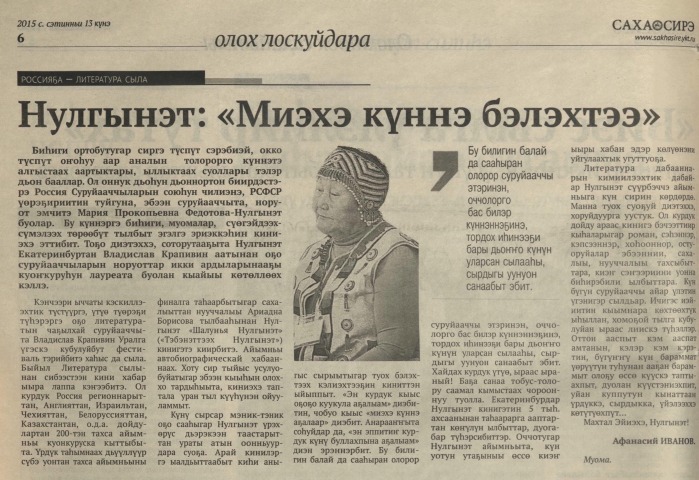
Источник: Саха сирэ. - 2015. - Сэтинньи 13 күнэ. - С. 6.
Количество страниц: 1 с.
- Литературный Север > Живая связь времен: современная литература народностей Севера, Сибири и Дальнего Востока > Эвенские писатели и поэты > Федотова Мария Прокопьевна — Нулгынэт (1946) > О жизни и деятельности,
- Языкознание. Филология. Художественная литература,
- КНИГАКАН > Все народы > Эвены (тунгусо-маньчжурская группа языков) > Литературоведение.
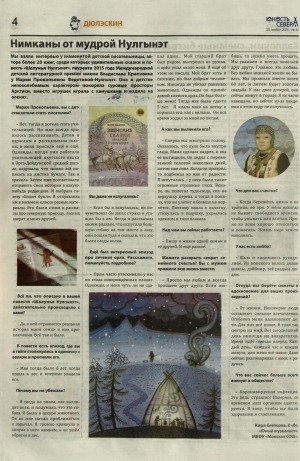
Источник: Юность Севера. - 2020. - 20 ноября (N 47). - С. 4.
Количество страниц: 1 с.
- Литературный Север > Живая связь времен: современная литература народностей Севера, Сибири и Дальнего Востока > Эвенские писатели и поэты > Федотова Мария Прокопьевна — Нулгынэт (1946) > О жизни и деятельности,
- Языкознание. Филология. Художественная литература,
- КНИГАКАН > Все народы > Эвены (тунгусо-маньчжурская группа языков) > Литературоведение.
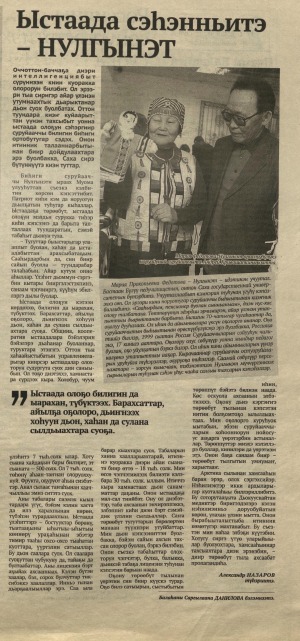
Источник: Саха сирэ. - 2014. - Алтынньы 30 күнэ. - С. 5.
Количество страниц: 1 с.
- Литературный Север > Живая связь времен: современная литература народностей Севера, Сибири и Дальнего Востока > Эвенские писатели и поэты > Федотова Мария Прокопьевна — Нулгынэт (1946) > О жизни и деятельности,
- Языкознание. Филология. Художественная литература,
- КНИГАКАН > Все народы > Эвены (тунгусо-маньчжурская группа языков) > Литературоведение.
Источник: Чолбон. - 2020. - N 04. - С. 47-52.
Количество страниц: 5 с.
- Сказочный мир > Сказки народов Севера и авторские сказки,
- Санги Владимир Михайлович > Произведения, переводы, предисловия, публицистика,
- Жирков Александр Николаевич > Переводы,
- Языкознание. Филология. Художественная литература,
- КНИГАКАН > Все народы > Нивхи (палеоазиатская группа языков) > Художественная литература.
Количество страниц: 11 с.
- 1. Игонина Светлана Викторовна. Медицинская тема в русской литературе = Medical theme in Russian literature
- 2. Ноева Елена Евгеньевна, Яндубаева Лидия Сергеевна . Исследование финансового потенциала муниципального образования Арктической зоны (на примере Жиганского района РС (Я) = A study of the financial potential of the municipality of the Arctic zone: the case of Zhigansky district of the Republic of Sakha (Yakutia))
- 3. Яковлева Евдокия Павловна. Роль жизнестойкости в адаптации молодёжи к новым реалиям = The role of resilience in youth adaptation to new realities
- 4. Дишкант Елена Валерьевна, Соловьева Мария Сергеевна. К 80-летию доктора педагогических наук, профессора Светланы Максимовны Петровой = On the 80th anniversary of Doctor of Pedagogical Sciences, Professor Svetlana Maksimovna Petrova
- 5. Неустроева Анна Николаевна. Профессор Августина Васильевна Иванова: учёный, педагог, созидатель = Professor Augustina Ivanova: scholar, teacher, creator
- 6. Калаврий Татьяна Юрьевна, Федоров Юрий Юрьевич. Адаптация методических рекомендаций к потенциалу опорного населенного пункта на примере городского поселения Алдан в Республике Саха (Якутия) = Adaptation of methodological recommendations to the potential of a key settlement: the case of the urban settlement of Aldan, Yakutia
- 7. Сибилева Елена Валерьевна, Ефимова Арина Александровна. Техногенные катастрофы и вызовы природопользованию в регионе Республика Саха (Якутия) = Man-made disasters and challenges to environmental management in the Sakha Republic (Yakutia)
- 8. Винокурова Марфа Александровна. Развитие событийного туризма на территории Республики Саха (Якутия) = Development of event tourism in the Republic of Sakha (Yakutia)
- 9. Баттахов Петр Петрович. Особенности правового регулирования территорий Дальневосточного федерального округа и Арктической зоны с преференциальным режимом = Peculiarities of legal regulation of the territories of the Far Eastern Federal District and the Arctic zone with preferential treatment
- 10. Васягина Наталия Николаевна, Градинар Екатерина Васильевна. Психологические особенности восприятия детско-родительских отношений в семьях, воспитывающих младших подростков = Psychological features of perception of parent-child relationships in families raising young adolescents
- 11. Болотаева Ольга Сергеевна. Некоторые аспекты правового регулирования цифровых платформ в Российской Федерации = Some aspects of the legal regulation of digital platforms in the Russian Federation
- 12. Ефимова Мария Прометеевна. Криминогенные детерминанты насильственного поведения в сфере семейных отношений = Criminogenic determinants of violent behavior in the field of family relations
- 13. Корякина Зинаида Ивановна. К вопросу об обязательном участии защитника в уголовном судопроизводстве = On the issue of mandatory participation of a defense attorney in criminal proceedings
- 14. Павлова Арзулана Акрамовна. К вопросу о понятии "цифровая преступность" = On the concept of "digital crime"
- 15. Парфенова Ольга Афанасьевна, Николаев Алексей Ильич. Леналенд: анализ геополитического статуса Якутии в XXI веке = Lenaland: analysis of Yakutia’s geopolitical status in the 21st century
- 16. Горохова Анна Ивановна, Сидоров Ян Николаевич. История урбанонимов г. Якутска как индикатор политики памяти = History of urbanonyms the city of Yakutsk as an indicator of memory policies
- 17. Шишкина Светлана Кирилловна, Новиков Виталий Николаевич. История международных спортивных игр "Дети Азии" = The history of international sports games for "Asian Children"
- 18. Корякина Анжелина Анатольевна. Межкультурный мировоззренческий подход как стратегия воспитания личности = Intercultural worldview approach as a strategy for personality development
- 19. Якса Наталья Владимировна, Платонова Раиса Ивановна. Нравственная культура как основа педагогического мастерства учителя = Moral culture as the foundation of teacher pedagogical excellence
- 20. Давлетбаков Арслан Асхатович, Бабичева Рита Исмагиловна, Семенова Мария Николаевна, Корзникова Елена Александровна. Анализ влияния ближнего порядка на механизмы деформации при сдвиге высокоэнтропийных сплавов TiNbZrV и TiNbZrhf = Analysis of short-range ordering effect on shear deformation mechanisms of high-entropy alloys TiNbZrV and TiNbZrhf
- 21. Хохолова Ирена Семеновна. Особенности цветообозначений в эпосе и способы их перевода с якутского на французский язык = Features of color meanings in the epic and their translation strategies from Yakut into French
- 22. Федоров Артур Григорьевич, Жондорова Любовь Леонидовна, Федорова Любовь Константиновна. Методы оценки и анализа разрешающей способности цифровых голографических микроскопов = Method for estimating and analyzing the resolution of digital holographic microscopy
- 23. Самсонова Лариса Николаевна. Лексико-семантические и структурно-грамматические характеристики эргонимов г. Якутска = Lexical-semantic and structural-grammatical characteristics of ergonyms in Yakutsk
- 24. Слепцова Галина Николаевна. Наименования мер длины – компоненты фразеологизмов, пословиц и поговорок в якутском, русском и английском языках = Names of length measures – components of phraseological units, proverbs and sayings in Yakut, Russian and English
- 25. Яковлева Любовь Анатольевна, Евтухова Алина Максимовна. Лингвокультурные особенности русских и эвенкийских гидронимов Южной Якутии = Linguocultural characteristics of Russian and Evenki hydronyms in South Yakutia
- 26. Сивцева Наталия Александровна. Сообщение о Всероссийской научно-практической конференции "Актуальные проблемы лексической и грамматической семантики", посвященной 75-летию со дня рождения доктора филологических наук Николая Николаевича Ефремова = A review of the All-Russian scientific and practical conference “Current problems of lexical and grammatical semantics” dedicated to the 75th anniversary of the birth of Doctor of Philological Sciences Nikolay Nikolaevich Efremov
- 27. Илларионов Василий Васильевич, Илларионова Туяра Васильевна. Творческий феномен С. А. Зверева – Кыыл Уола и его значение для сохранения якутского фольклорного наследия = The creative phenomenon of Sergey Zverev – Kyyl Uola and its significance for the preservation of Yakut folklore heritage
- 28. Сатанар Марианна Тимофеевна. Эпосы олонхо и нимкан в контексте знаковых систем = The epics of Olonkho and Nimkan in the context of sign systems
- 29. Жиркова Евгения Егоровна. Образная лексика звукомимического происхождения, характеризующая выражение лица персонажей олонхо = Figurative vocabulary of sound-mimic origin characterizing facial expressions of olonkho characters
- 30. Саввинов Василий Михайлович. Оценка вовлеченности молодежи в образовательные инициативы = Evaluation of youth involvement in educational initiatives
- 31. Борисова Валерия Сергеевна. Общетюркская аналитическая конструкция в абыйском говоре якутского языка (на материале полевых исследований) = The Turkic analytical construction in the Abyi dialect of the Yakut language (based on field research)
- 32. Давыдова Лиана Николаевна, Иванова Саргылана Владимировна. Перевод терминологии индустрии красоты на якутский язык. Кэрэ эйгэтин тиэрминнэрин сахалыы тылбааhа = Translation of beauty industry terminology into the Yakut language
- 33. Ефимова Людмила Степановна. Термины национальной гастрономической культуры якутов в записях Я. И. Линденау (I половина XVIII в.) = Terms of the national gastronomic culture of the Yakuts in the records of Jacob Lindenau (first half of the 18th century)
- 34. Ефремова Надежда Анатольевна, Семенова Светлана Владимировна. Лексико-семантический анализ имен собственных якутского эпоса олонхо = Lexical and semantic analysis of proper names in the Yakut epic olonkho
- 35. Яковлева Любовь Анатольевна, Кутузова Виктория Максимовна. Семантика топонимического пространства Южной Якутии как инструмент патриотического воспитания = Semantics of the toponymic space of Southern Yakutia as a tool for patriotic education
- 36. Пшенникова Галина Максимовна, Николаева Татьяна Яковлевна, Адамова Рената Николаевна. Распространенность и терапия эпилепсии в Якутии = Prevalence and treatment of epilepsy in Yakutia
- 37. Пинелис Иосиф Семенович, Петрова Александра Моисеевна, Малежик Маргарита Сергеевна, Шнитова Ирина Валерьевна, Ушницкий Иннокентий Дмитриевич. Роль дисбиоза полости рта в патологии органов дыхания и системных заболеваниях = The role of oral dysbiosis in respiratory pathology and systemic diseases (literature review)
- 38. Вестник Северо-Восточного федерального университета им. М. К. Аммосова, 2025, №3 (101)
The article is devoted to the study of the symbolic semantics of insects (mosquito, louse, beetle, caterpillar) in the context of various genres of Even folklore. The relevance of this study is justified by the lack of a comprehensive analysis of this topic in the context of Even folklore. This study is of fundamental importance for understanding the cultural and spiritual heritage of the Evens, as well as for an in-depth understanding of the mechanisms of mythologization and symbolization in traditional societies. The novelty of the work lies in the fact that for the first time a comprehensive analysis of insect images in Even folklore is carried out, which allows us to expand existing knowledge about the mythopoetic picture of the world of the ethnic group and identify unique aspects of its cultural code. The aim of the study is to identify and analyze the mythological, symbolic and cultural functions of the mosquito, louse, beetle, caterpillar in Even folklore, as well as to determine their place in the system of traditional Even ideas about the world and nature. To achieve this goal, the following tasks were formulated: to identify the mythological and symbolic connotations associated with each of the insects studied; to determine the functional aspects of insects in the Even tradition. The study used a comprehensive methodological approach, including contextual analysis and semiotic research, which allowed not only to identify the superficial meaning of insect images in folklore, but also to reveal their deep symbolic and mythological essence. The analysis of Even folklore showed that insect images play an important role in shaping the mythological picture of the Even world. Myths about mosquitoes, in particular, symbolize the struggle between good and evil and inevitable troubles. Prohibitions on complaining about mosquitoes reflect mythological and educational aspects aimed at maintaining harmony with the environment. Lice among the Evens are multifunctional symbols that foretell trouble or death. Their appearance in a mythological context can be interpreted as a sign of intervention by supernatural forces. In the epic, lice symbolize the life cycle, which emphasizes their importance in understanding human destiny. Even signs associated with beetles indicate their connection with weather phenomena. The activity of beetles is considered an indicator of upcoming changes in nature, which indicates the Evens’ deep understanding of natural cycles. The hairy caterpillar in mythology acts as the spirit-master of the deer. The caterpillar symbolizes the cyclical nature of natural processes and the harmony between man and nature. The research prospects involve an in-depth study of the symbolic images of insects in Even folklore, as well as an expansion of the geographical and temporal context of the study to identify universal and specific characteristics of the perception of these images by different ethnic groups.
Кузьмина, Р. П. Символические образы насекомых в эвенском фольклоре / Р. П. Кузьмина ; Институт гуманитарных исследований и проблем малочисленных народов СО РАН // Вестник Северо-Восточного федерального университета им. М. К. Аммосова. Серия "Эпосоведение". - 2025. - N 3 (39). - С. 142-152. - DOI: 10.25587/2782-4861-2025-3-142-152
DOI: 10.25587/2782-4861-2025-3-142-152

Количество страниц: 20 с.
- Долганский язык > Научные труды,
- Учимся говорить на языках народов Севера > Долганский язык > Языкознание,
- Языкознание. Филология. Художественная литература > Языкознание и языки. Лингвистика > Тюркские языки,
- НАУКА ЯКУТИИ > ЯЗЫКОЗНАНИЕ. ФИЛОЛОГИЯ. ЛИТЕРАТУРОВЕДЕНИЕ. ХУДОЖЕСТВЕННАЯ ЛИТЕРАТУРА > Языкознание и языки. Лингвистика,
- КНИГАКАН > Языкознание. Лингвистика. Художественная литература. Литературоведение,
- КНИГАКАН > Все народы > Долганы (тюркская группа языков) > Языкознание.
The scientific problem of studying the language of one of the indigenous peoples of the Russian Federation - the Dolgan - is an urgent task of the humanities. The Dolgan language is one of the little-studied Turkic languages and is currently on the verge of extinction due to the small number of speakers, narrowing of the environment and scope of use. This trend is characteristic not only of the Dolgan language of Taimyr and Yakutia, but also of other indigenous peoples of the North, Siberia, the Arctic and the Far East. The purpose of the article is a retrospective study of the history of the origin of the Dolgan people and their language, as well as a description of its current status and development prospects. The material of the article is published works of domestic and foreign researchers, as well as the author’s own materials collected during expeditions to Taimyr and the Republic of Sakha (Yakutia) in different years. The article uses such research methods as descriptive, comparative- historical and direct observation of the language situation in the process of long-term practical work with Dolgan students at the Faculty of Peoples of the Far North and the Institute of Peoples of the North of the Herzen State Pedagogical University, as well as at the Department of Northern Philology of the Ammosov North-EasternFederal University. The article presents a brief outline of the grammar of the Dolgan language, a description of its main phonetic and lexical features. The work takes into account the materials and conclusions of the most important scientific works and educational and methodological works on the Dolgan language. The results of the work are presented in the form of a summary in the short conclusion of the article, which reflects the practical significance and prospects for studying the modern Dolgan language.
Петров, А. А.
Этнокультурное и социолингвистическое описание долганского языка / А. А. Петров ; Российский государственный педагогический университет им. А. И. Герцена // Арктика. XXI век. - 2025. - N 1 (39). - С. 76-95. - DOI: 10.25587/2310-5453-2025-39-1-76-95
DOI: 10.25587/2310-5453-2025-39-1-76-95

Количество страниц: 22 с.
- Юкагирский язык > Научные труды,
- Учимся говорить на языках народов Севера > Юкагирский язык > Языкознание,
- Языкознание. Филология. Художественная литература > Языкознание и языки. Лингвистика > Юкагирский язык,
- НАУКА ЯКУТИИ > ЯЗЫКОЗНАНИЕ. ФИЛОЛОГИЯ. ЛИТЕРАТУРОВЕДЕНИЕ. ХУДОЖЕСТВЕННАЯ ЛИТЕРАТУРА > Языкознание и языки. Лингвистика,
- КНИГАКАН > Языкознание. Лингвистика. Художественная литература. Литературоведение,
- КНИГАКАН > Все народы > Юкагиры (палеоазиатская группа языков) > Языкознание.
The article is devoted to a relevant and under-researched topic of foreign language influence on the Yukaghir language, spoken by one of the smallest ethnic groups in the northeastern part of Siberia, with fewer than 50 speakers, primarily residing in the Low Kolyma and Upper Kolyma regions of the Sakha Republic (Yakutia). Recent studies have shown that in the Tundra Yukaghir speech, there is a small group of Russian words, the borrowing of which would not have been possible without involvement of the affixal morpheme -laa from Yakut as an intermediary language. It has been established that the use of borrowed Yakut allomorphs -laa , -naa , -daa , -taa in Yukaghir aligns with the final sound of the stem, as in the source language. Based on the degree of assimilation, non-adapted, partially adapted (with assimilation of either the root or the affix), and fully adapted forms with -laa are distinguished, some of which are relatively frequent in the speech of native speakers and are integrated into the grammatical system of the recipient language. From a structural- morphological perspective, verbs, whether borrowed as complete forms or created by analogy with Yakut word-formation patterns, include nouns, imperative verb forms, and an interjection. The author provides a chronological-frequency analysis, according to which verbs with -laa should be considered phenomena of the Soviet period and the speech strategy of one speaker, although a small number of suchlexemes are reflected in a bilingual dictionary. The assimilation of the Yakut affix-laa became possible due to the widespread multilingualism among the Yukaghirs and the structural similarity between the Yukaghir and Yakut languages.
Курилова, С. Н.
Заимствования в юкагирском языке: якутский словообразовательный аффикс -лаа в речи тундровых юкагиров / С. Н. Курилова ; Северо-Восточный федеральный университет им. М. К. Аммосова // Арктика. XXI век. - 2025, N 1 (39). - С. 32-53. - DOI: 10.25587/2310-5453-2025-39-1-32-53
DOI: 10.25587/2310-5453-2025-39-1-32-53

Количество страниц: 12 с.
- Литературный Север > Живая связь времен: современная литература народностей Севера, Сибири и Дальнего Востока > Эвенские писатели и поэты > Об авторах,
- Языкознание. Филология. Художественная литература > Литература. Литературоведение > Теория литературы. Изучение литературы. Литературная техника > Художественная литература на отдельных языках,
- НАУКА ЯКУТИИ > ЯЗЫКОЗНАНИЕ. ФИЛОЛОГИЯ. ЛИТЕРАТУРОВЕДЕНИЕ. ХУДОЖЕСТВЕННАЯ ЛИТЕРАТУРА > Литература. Литературоведение,
- КНИГАКАН > Языкознание. Лингвистика. Художественная литература. Литературоведение,
- КНИГАКАН > Все народы > Эвены (тунгусо-маньчжурская группа языков) > Литературоведение.
Color designations in the linguistic picture of the world of any people are one of the central categories, since the primary development of the world by man occurs through the senses, in which vision is one of the most important organs of perception of the world. This paper examines the semantic feature of the words of color vocabulary in the artistic texts of Even poets and writers. The purpose of this article is to study color-denoting vocabulary in Even poetic and prose texts. The main task is to determine the composition and formation of coloratives in Even lyrics and prose. The theoretical significance of this study is that the results of the analysis contribute to the study of the language and style of Even poets and writers. We used and analyzed the works of art of Even writers and poets Nikolai Tarabukin, Vasily Lebedev, Vasily Keymetinov-Bargachan, Andrey Krivoshapkin, Maria Amamich, Varvara Arkuk, Anatoly Stepanov. Stories, short stories, poems in the Even language were analyzed and color epithets were identified and their semantics were considered: “nyobati” (white) this epithet is the most important, key color in Even poetry, it personifies everything white that surrounds the Evens – winter, snow, animals, sacred deer, etc.; or to denote the color silver – the epithet “meӈen” in the prose work of Amamich. Various color designations are described, some positions in which color epithets are used in various aspects and their frequency are revealed, as Even writers and poets use color vocabulary in their own way.
Винокурова, А. А.
Цветовой эпитет в эвенской литературе: особенности семантики / А. А.Винокурова, Н. И. Колесова ; Северо-Восточный федеральный университет им. М. К. Аммосова / /Вестник Северо-Восточного федерального университета им. М. К. Аммосова. Серия "Алтаистика". - 2025, N 2 (17). - С. 27-38. - DOI: 10.25587/2782-6627-2025-2-27-38
DOI: 10.25587/2782-6627-2025-2-27-38